Serving Toronto & Across Ontario  ·  289-547-5911 · Toll Free 1-866-248-0567  ·  info@criticaltraumatherapy.com
TMS & Neurofeedback

TMS & Neurofeedback Therapy in Oakville

You have tried medication, perhaps more than once. You have done the work in therapy. And something still feels stuck. That is not a failure on your part. It may simply mean your brain needs a different kind of support.

BrainsWay Deep TMS for treatment-resistant depression, anxious depression, OCD and PTSD, psychiatrist-led and guided by qEEG brain mapping, with neurofeedback and biofeedback alongside it. Delivered in person at our Oakville clinic inside Oakville Trafalgar Memorial Hospital, serving Oakville, Burlington, Milton, Mississauga, Toronto and the western GTA.

Start with a free information session. Ask every question you have and get an honest answer, with no obligation to proceed.
Drug-Free
No medication, surgery or sedation
20 to 40 Min
Per session, and you drive yourself home
Oakville
Inside Oakville Trafalgar Memorial Hospital
Plain Language

What Is TMS Therapy?

TMS stands for Transcranial Magnetic Stimulation. Think of it as physical therapy for the brain: just as a physiotherapist uses targeted techniques to restore movement, transcranial magnetic stimulation uses gentle magnetic pulses to stimulate the areas of the brain involved in mood, behaviour and concentration. It is a form of non-invasive brain stimulation, not a medication and not surgery.

How It Works

Transcranial simply means through the skull. A coil rests gently against your head and delivers focused magnetic pulses, similar to the technology used in an MRI scanner but aimed at specific regions of the brain.

The pulses help restore healthier patterns of brain activity, without surgery, sedation or medication.

Established, Not Experimental

TMS has been in clinical use for more than twenty years and is approved by both Health Canada, since 2002, and the FDA. Deep TMS has been used with more than 100,000 patients worldwide.

It is not a last resort. For depression that has not responded to medication and therapy, it is simply the reasonable next step.

What a Session Is Like

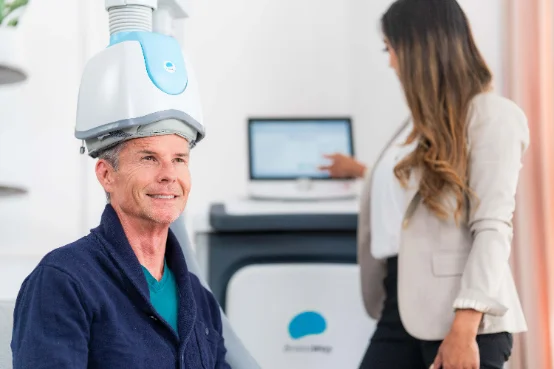
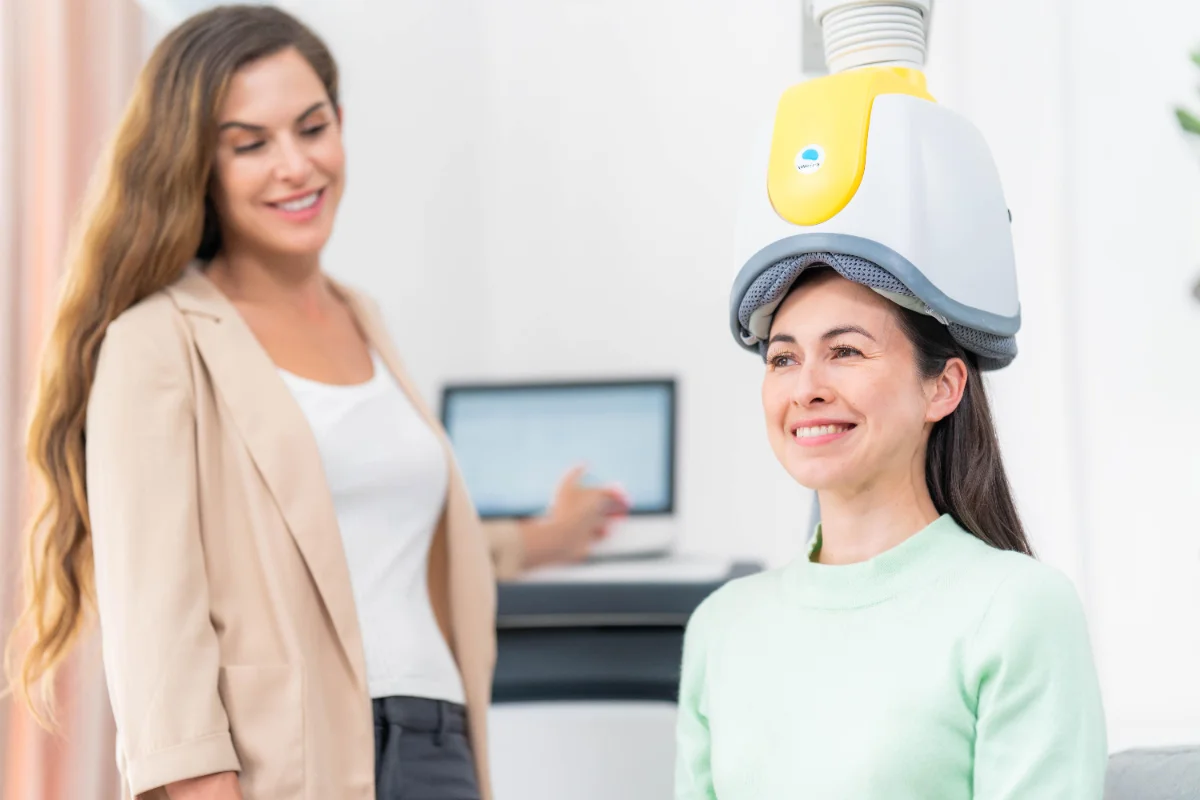
You sit in a comfortable chair, fully awake, with nothing to do. You will hear a clicking sound and feel a mild tapping on your scalp. Both are normal and stop when the session does.

Most people read, listen to music, or simply rest. Sessions take 20 to 40 minutes and you can drive yourself home afterwards and carry on with your day.

Who It Is For

Adults whose depression, anxious depression, OCD or PTSD has not improved enough with medication and therapy, and who would rather not keep trying further prescriptions.

Suitability is confirmed at a psychiatric consultation before anything begins. If we do not think TMS is the right treatment for you, we will say so and explain what we would suggest instead.

The Difference

Not All TMS Is the Same

The depth a machine can reach determines which parts of the brain it can actually influence, and that matters a great deal for trauma and for conditions that have not responded to other treatment.

Traditional TMS

Reaches only 1 to 2 centimetres into the brain, stimulating the surface.

It cannot reach the deeper emotional centres, which limits its usefulness for PTSD and more complex presentations.

BrainsWay Deep TMS, Used Here

Penetrates 4 to 6 centimetres, two to three times deeper, using a patented H-coil.

That reach includes the limbic and subcortical regions involved in trauma, which is why it is effective for PTSD and OCD as well as depression. More than sixty peer-reviewed studies support it, including trials published in World Psychiatry, JAMA Psychiatry and the American Journal of Psychiatry.

Conditions

What TMS Can Treat

Approved by Health Canada and the FDA for the conditions below, and used for others where a physician considers it appropriate. Tap any one to read more.

Major Depressive Disorder

Where depression has not responded to medication or talk therapy, TMS therapy for depression offers a drug-free route towards meaningful relief and a return to ordinary daily function. Treatment-resistant depression is the condition Deep TMS is most often used for.

This is the condition TMS is best established for, with the longest research history behind it.

Anxious Depression

A distinct condition combining persistent anxiety with depression, and one that often responds poorly to medication and therapy alone.

Deep TMS is approved for it specifically, rather than being used off-label.

Obsessive Compulsive Disorder

For people living with OCD who have not found lasting relief, Deep TMS works directly on the brain pathways involved in the obsessive and compulsive cycle.

Published research shows a meaningful reduction in OCD symptoms for a substantial proportion of people treated.

Smoking Cessation

Deep TMS is FDA-approved to support stopping smoking, by targeting the brain regions associated with craving and habit.

Useful where willpower and nicotine replacement have not been enough.

PTSD and Trauma, Including After a Collision

Used off-label on physician assessment. Because Deep TMS reaches the limbic regions involved in the trauma response, it can help where standard TMS cannot.

This matters particularly for our accident clients, where PTSD, driving anxiety and intrusive memories persist despite good trauma therapy.

Other Off-Label Uses

On physician assessment, TMS is also used for chronic migraine, for tinnitus, for cognitive support following traumatic brain injury or with ageing, for addictions including alcohol and substance use, often paired with neurofeedback, and as a supportive approach for sensory and emotional regulation difficulties on the autism spectrum.

We will always be clear with you about what is approved, what is off-label, and what the evidence currently shows.

Measured, Not Guessed

A Window Into Your Brain: qEEG Brain Mapping

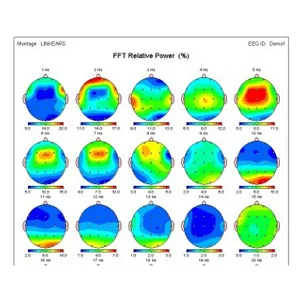
Every course of TMS here begins with a qEEG, a painless twenty-minute scan that measures your brain’s electrical activity and identifies the regions driving your symptoms. Nothing is injected and nothing hurts.

We are one of only two private clinics in Ontario offering FDA-cleared qEEG alongside TMS treatment. It gives us three things: an objective baseline of how your brain is functioning now, a precise target for your treatment rather than a one-size-fits-all protocol, and a second scan at the end so your progress is documented rather than estimated.

Many people find that second scan the most reassuring part of the whole course. Seeing the change on a screen tends to confirm what you have been feeling.
Step by Step

What Your Course Looks Like

Eight stages, in order, from the first conversation to a plan for keeping your gains once treatment ends. Tap any step to read what it involves.

Free Information Session

Ask every question you have. We explain TMS in plain language, describe what to expect, and help you decide whether it is the right fit. There is no cost and no pressure to proceed.

Psychiatric Consultation

One of our psychiatrists reviews your history, your current symptoms and the treatments you have already tried, to confirm TMS is appropriate and to determine how many sessions you are likely to need.

Baseline qEEG Brain Mapping

A painless twenty-minute scan of your brain’s electrical activity, creating a map of how it is functioning before treatment begins. This is what allows us to target your treatment rather than follow a standard protocol.

Motor Threshold Calibration

Your technician calibrates the pulse intensity to your own brain’s response, so treatment is precise and comfortable from the very first session.

Treatment Phase

Daily sessions, typically five days a week over four to six weeks. Each session takes 20 to 40 minutes, you stay awake throughout, and you drive yourself home afterwards. Ask us about accelerated TMS if that schedule is not workable for you.

Midpoint Review

Halfway through your course, your psychiatrist checks how you are feeling, reviews your progress, and adjusts the plan if anything needs to change.

Final Review and Second qEEG

A closing psychiatric review, and a second brain scan documenting how your activity has changed. Most people find this the most reassuring part of the course, because it confirms on screen what they have been feeling.

Aftercare and Maintenance Planning

Your care does not end when the sessions do. We build a plan with you for holding on to the progress you have made, including counselling or maintenance sessions where those would help.

A Faster Option

Accelerated TMS

Four to six weeks of daily visits is not possible for everyone, and some people simply want relief sooner.

How It Differs

Accelerated TMS is an evidence-based protocol that condenses a full course into several sessions a day across a much shorter window.

Very few clinics in Ontario offer it, and it makes Deep TMS accessible to people whose work, childcare or travel rules out the standard timeline.

Who It Suits

People travelling from outside the area, those who cannot take weeks away from work, and anyone for whom waiting six weeks feels like too long.

Suitability is decided at your psychiatric consultation. We will tell you honestly if the standard protocol would serve you better.

Alongside TMS

Neurofeedback & Biofeedback

Two further drug-free approaches that train the brain and nervous system to regulate themselves, used for anxiety, PTSD and trauma symptoms, depression, ADHD, insomnia, chronic pain, migraines, emotional regulation, and the cognitive fog that follows a concussion. Neurofeedback is offered at our Oakville clinic; biofeedback can also come to you.

Neurofeedback, at Our Oakville Clinic

Sensors record your brainwave patterns and feed that information back to you in real time, usually through a game, a sound or an image that responds to what your brain is doing.

Over a course of sessions the brain learns to settle into more regulated patterns. There is nothing to do consciously, which many people find a relief after years of being told to think differently.

Used for anxiety, depression, ADHD, attention and concentration difficulties, sleep disturbance, emotional regulation, and the persistent hyperarousal that often follows trauma. Suitable for children as well as adults, and frequently chosen by families looking for a drug-free option for ADHD.

Neurofeedback is available only at our Oakville clinic, alongside TMS and qEEG brain mapping.

Biofeedback, in Clinic or at Home

Biofeedback makes your physiological state visible. Heart rate and heart rate variability are recorded and displayed while you learn techniques to bring your nervous system down out of alarm.

Because you can see the effect immediately, it teaches self-regulation far faster than instruction alone. It is particularly useful for panic, driving anxiety and pain.

Unlike neurofeedback, biofeedback does not require our Oakville equipment. We deliver it in your own home alongside our virtual reality graded exposure work, so you can practise in the setting where you actually need it.

We also use biofeedback within our Mental Health Driving Anxiety Assessment©, where physiological response is measured while graded driving scenarios are presented through FDA-cleared virtual reality.

Location

Where TMS Is Offered

In person at our Oakville clinic, inside Oakville Trafalgar Memorial Hospital at 3001 Hospital Gate, Unit 6, serving Oakville, Burlington, Milton, Mississauga, Toronto and the western GTA. Park in the hospital visitor car park and bring your ticket to reception, and we will validate it for you, so parking costs you nothing on treatment days.

Travelling to Us

Oakville is currently our only location offering BrainsWay Deep TMS, qEEG brain mapping and neurofeedback. If you live elsewhere in Ontario you are still very welcome.

People attend from across the GTA, Niagara, Hamilton, Kitchener-Waterloo and further afield for their course of treatment. Where travel is the obstacle, ask us about accelerated TMS, which requires far fewer visits.

Support Around the Treatment

Some preparation and follow-up can be handled virtually where that is appropriate, so not every contact requires a trip to Oakville.

Counselling, physiotherapy and dietitian care are available at our other clinics, at home, or online, and CBT is integrated into every TMS course so your thinking is supported alongside the treatment itself. See our virtual therapy and areas we serve pages.

Honest Answers

Common Questions and Misconceptions

TMS is one of the most misunderstood treatments in mental health. Here is what the evidence actually shows.

Is TMS the same as electroshock therapy?

No, and they are not comparable. TMS uses focused magnetic pulses rather than electricity. There is no anaesthetic, no sedation, no memory loss and no recovery period.

You stay awake throughout, and you drive yourself home afterwards. The risk of seizure is extremely rare, under 0.1 per cent.

Is it still experimental?

No. TMS has been approved by Health Canada since 2002 and by the FDA, with more than twenty years of clinical use and over 100,000 people treated with Deep TMS worldwide.

More than sixty peer-reviewed studies support the technology we use.

Does it hurt, and are there side effects?

Most people describe a mild tapping sensation on the scalp during the session. Some have a headache or scalp tenderness in the first few sessions, which usually settles.

Unlike medication, TMS does not cause weight gain, sexual side effects or emotional blunting.

How long before I notice a difference?

Most people begin noticing change part way through the course rather than in the first week. Your psychiatrist reviews progress at the midpoint.

The second qEEG at the end gives you an objective picture of what has changed, alongside how you feel.

Is it covered, and what does it cost?

TMS is not covered by OHIP. Some extended health insurance plans contribute towards it, and we will check your coverage with you before anything is booked.

We will explain the cost clearly at your free information session, before you commit to anything. Financing is available, and we will work within your budget.

Will I have to stop my medication?

No. TMS is usually delivered alongside existing medication rather than instead of it, and any change to your prescription is a decision for your psychiatrist and you.

Nothing is stopped abruptly, and nobody will ask you to choose between the two.

Beyond TMS

Explore More Ways We Can Help

Two more parts of Critical Trauma Therapy worth a look.

CTT Wellness Division

Proactive mental wellness, stress management, and preventive care for people who want support before a crisis.

CTT Wellness →

In-Home & Virtual Therapy

If getting to a clinic is difficult, counselling can come to you at home or online anywhere in Ontario, with physiotherapy home visits from Hamilton through to Niagara.

Learn More →

Ready When You Are

Weekday appointments 9 to 5:30, evenings and weekends by appointment — in clinic, at home, or online.

Book an Intake Call Submit a Referral